Introduction
In industrial installations, and more particularly in sensitive areas such as battery rooms, nuclear facilities or technical rooms, the quality of air renewal is a major safety issue.
Poor air circulation can lead to the formation of dead zones ("dead zones"), that is to say regions where the air is very poorly renewed. These volumes can then become accumulation zones for contaminants and increase several risks:
- Risk of anoxia : accumulation of nitrogen (N₂) leading to a decrease in oxygen concentration (O₂ < 17 %). Nitrogen being odourless, this risk is particularly difficult to detect.
- Explosion risk : accumulation of hydrogen (H₂), particularly in battery rooms, which can lead to reaching the lower explosive limit.
- Radiological risk : accumulation of radioactive gases (iodine) or radioactive aerosols (for example cesium 137).
- Health or contamination risk : in clean rooms or laboratories for example.
The objective of this study is to propose indicators to objectively assess the quality of air mixing in a room and to identify inadequately ventilated areas using CFD simulations.
The limits of the air renewal rate
The most commonly used indicator for qualifying ventilation is the air change rate (ACR).
where :
- ACR is expressed in volumes per hour (Vol/h),
- Q is the volumetric air flow rate,
- V is the volume of the room.
This indicator allows for the comparison of different installations but has an important limitation: it provides no information on the distribution of ventilation within the room.
Two rooms with exactly the same air change rate can exhibit very different behaviours:
- a perfectly mixed room;
- a room containing several nearly stagnant volumes.
The air change rate is therefore a global indicator but insufficient to detect dead zones.
The phenomena influencing the quality of ventilation
Air circulation depends on many geometric and thermal parameters.
The main parameters are divided into two groups:
Geometric conditions
- room geometry;
- presence of obstacles;
- position of air inlets;
- position of air outlets;
- dimensions of openings;
- orientation of the jet of air.
and boundary conditions
- air flow rate;
- supply temperature;
- wall temperature;
- power dissipated in the room;
- internal cooling systems.
The combination of these phenomena modifies the structure of the flows and can promote the appearance of recirculations or poorly ventilated volumes.
Selected methodology
Several levels of modelling can be used to study dead zones.
The objective of this study is to use an approach CFD RANS with :
- simplified geometries ;
- a relatively coarse mesh.
This approach allows for the identification of the main physical trends. Cases of particular interest can then be validated by more detailed CFD models (fine meshes, complete geometries or transient simulations).
Study assumptions
In order to generalise the analysis, several assumptions are made. Firstly, the position of the contamination source is assumed to be unknown. Secondly, the contaminant is considered not to influence the flow :
- either because its physical properties are close to those of air ;
- or because its concentration remains sufficiently low.
Gaseous contaminants are assumed to be perfectly mixed with air.
When the contaminant consists of solid particles, they are assumed to have a Stokes number much less than 1, which means they follow the streamlines.
When these assumptions are no longer verified, a specific study becomes necessary.
The age of air: a local indicator of ventilation
To characterise the actual air renewal, the concept is introduced air age.
The air age represents the time elapsed since an air particle entered the room.
Numerically, it is modelled as a passive scalar:
Each cell in the calculation "ages" at a rate of one second per second, while convection transports this information throughout the domain.

In some simplified analyses, the diffusion of air age can be neglected, leading to a simpler equation.
From this local quantity, the mean air age in the room is calculated:
In the case below, the mean age is 2 seconds:
Unlike the renewal rate, the air age provides complete spatial information about the quality of mixing.
Ventilation efficiency
In order to compare different configurations, the overall ventilation efficiency is introduced.
It compares:
- the theoretical minimum time required to completely renew the room;
- the time actually observed in the simulation.
This quantity ranges from 0 to 1.
An efficiency close to 1 indicates very effective renewal.
Low efficiency indicates that a significant part of the volume is poorly ventilated.
Overall efficiency thus provides a synthetic indicator of ventilation quality.
Local efficiency applies the same principle to each cell in the calculation.
This results in a mapping of the air renewal quality throughout the room.
This representation allows for immediate identification of the least ventilated areas.
Definition of dead zones
A dead zone corresponds to an area where the air is practically never renewed.
Mathematically, this translates to:
- an air age tending towards infinity;
- a ventilation efficiency tending towards zero.
In practice, a true dead zone is relatively rare.
Much more frequently, we encounter poorly ventilated zones, in which the air age converges towards a high value.
These areas are defined using thresholds on:
- the average age;
- the local age;
- the overall efficiency;
- the local efficiency.
The choice of these thresholds depends on the industrial application considered.
Concrete case
Consider a ventilated room with an air inlet on the right facade and an extraction on the left facade. The block on the floor represents a heat source (pump, battery, transformer, etc.). Two phenomena govern the mixing of air here:
- the forced convection, induced by ventilation through the openings located on the opposite upper facades;
- the natural convection, related to the heating of the air in contact with the walls and the heat source.
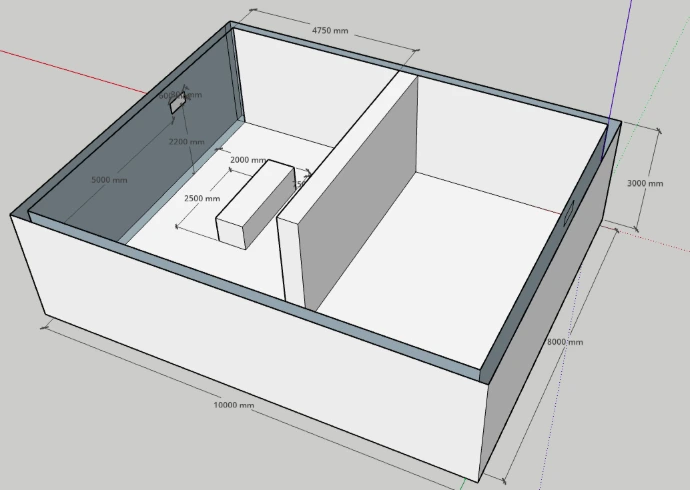
At first glance, the presence of an obstacle in the centre of the room (here a wall) could promote the appearance of a dead zone. Indeed, the airflow is partially blocked and the area downstream of the wall seems less well ventilated.
However, the presence of the heat source generates an upward thermal plume that moves the air in the second part of the room and contributes to its mixing. This plume also interacts with the main flow from the ventilation, leading to the formation of a recirculation zone in one of the upper corners of the room. The air is renewed more slowly there, resulting in lower ventilation efficiency and promoting the appearance of a poorly ventilated area.
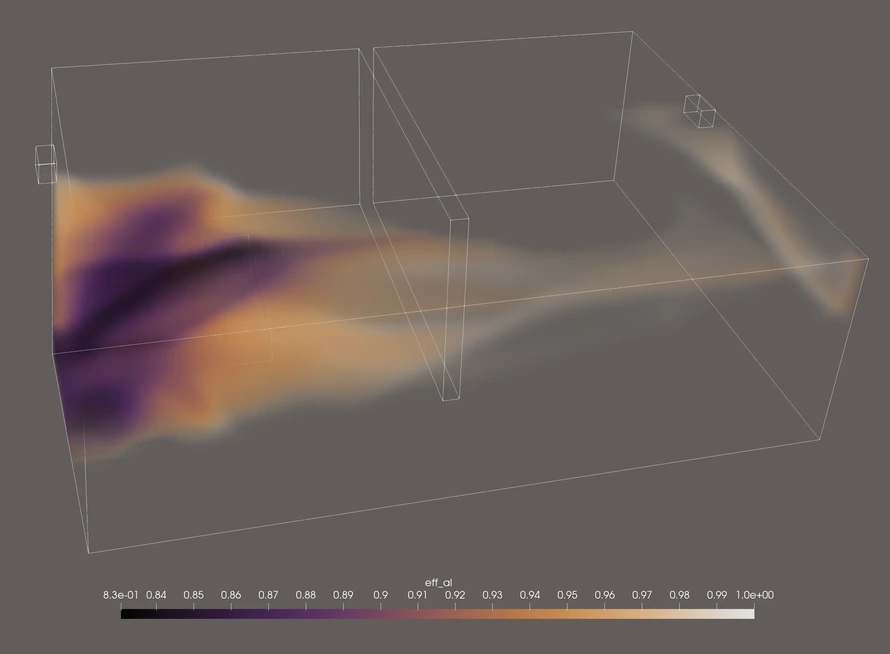
Intuitively, one might think that increasing the ventilation flow would improve air mixing. In reality, in this configuration, it strengthens the recirculation vortex and traps more air in that area, thereby reducing the local efficiency of the ventilation.
Conclusion
The age of the air is a much more relevant indicator than the simple renewal rate for characterising the quality of ventilation.
Combined with overall and local efficiency indicators, it allows for the quantitative identification of dead zones and inadequately ventilated volumes.
The presented parametric study constitutes a first step towards a methodology that links the geometric characteristics and operating conditions of a space to the actual quality of its air mixing.
This approach can notably be applied to nuclear ventilation studies, where the control of flows and the identification of inadequately ventilated areas contribute to the verification of design criteria and to the management of explosion, contamination, or gas accumulation risks.
Authors :

Nicolas Cardin
Business Development Director
Doctor in fluid mechanics, he has crossed to the dark side and taken on a sales role by joining SIL3X. Able to juggle between technical discussions and client needs, he follows the missions and attends various trade shows to meet you.

Matthieu Descombes
CFD Director
The quiet strength. Matthieu is our CFD expert, he is capable of conducting complete studies despite tight deadlines. His secret? Years of experience, an ability to hit the mark without going beyond the initial need, and in-house scripts to optimise model creation!