Introduction
What happens in a technical room after a loss of ventilation? How long can a thermosensitive piece of equipment continue to operate? What pressure does a building reach after a steam leak?
These situations require simultaneous representation of equipment, walls, ventilation, thermal exchanges, and sometimes phase changes.
To address these issues, EDF R&D and SIL3X are developing TAeZoSysPro, a Modelica library dedicated to thermal and airflow studies of industrial installations.
It allows for the construction of dynamic models to study the behaviour of an installation, from its normal operation to incidental or accidental situations.
Why not another building thermal library?
Several Modelica libraries already exist for thermal applications, notably Buildings and BuildSysPro. They mainly target tertiary buildings and their energy systems.
TAeZoSysPro positions itself as a complement, addressing specifically industrial needs:
- finely modelled dissipative equipment (electrical cabinets, transformers) rather than flat internal loads;
- an explicit separation of convective and radiative, via Carroll's method and an average radiation temperature;
- a bi-species humid air capable of managing the total disappearance of one species, a common situation when an atmosphere initially composed of air is gradually replaced by steam;
- mass-energy calculations with evaporation, condensation, and boiling.
The library remains compatible with the interfaces of the Modelica Standard Library, allowing it to be assembled with existing models rather than starting from a blank page.
What the library contains
TAeZoSysPro is organised around four modules:
| Module | Object |
|---|---|
| Thermal transfers | Conduction, convection, radiation, walls, inert masses, exchangers |
| Fluid dynamics | Air flows, mass-energy transfers, phase changes |
| Media | Thermodynamic properties, humid air in density-temperature formulation |
| PDE | Spatial discretisation schemes for transport phenomena |
For the description of the zonal approach itself and its relevance to the calculation of a grace period, we refer to our article HVAC sizing: validating thermal transients.
Room with electrical cabinets — ZEPHYR installation
EDF R&D has a full-scale instrumented test facility, representative of the electrical and control rooms encountered in nuclear power plants. It allows for the measurement of temperature fields in the air and in the walls under controlled and repeatable conditions.
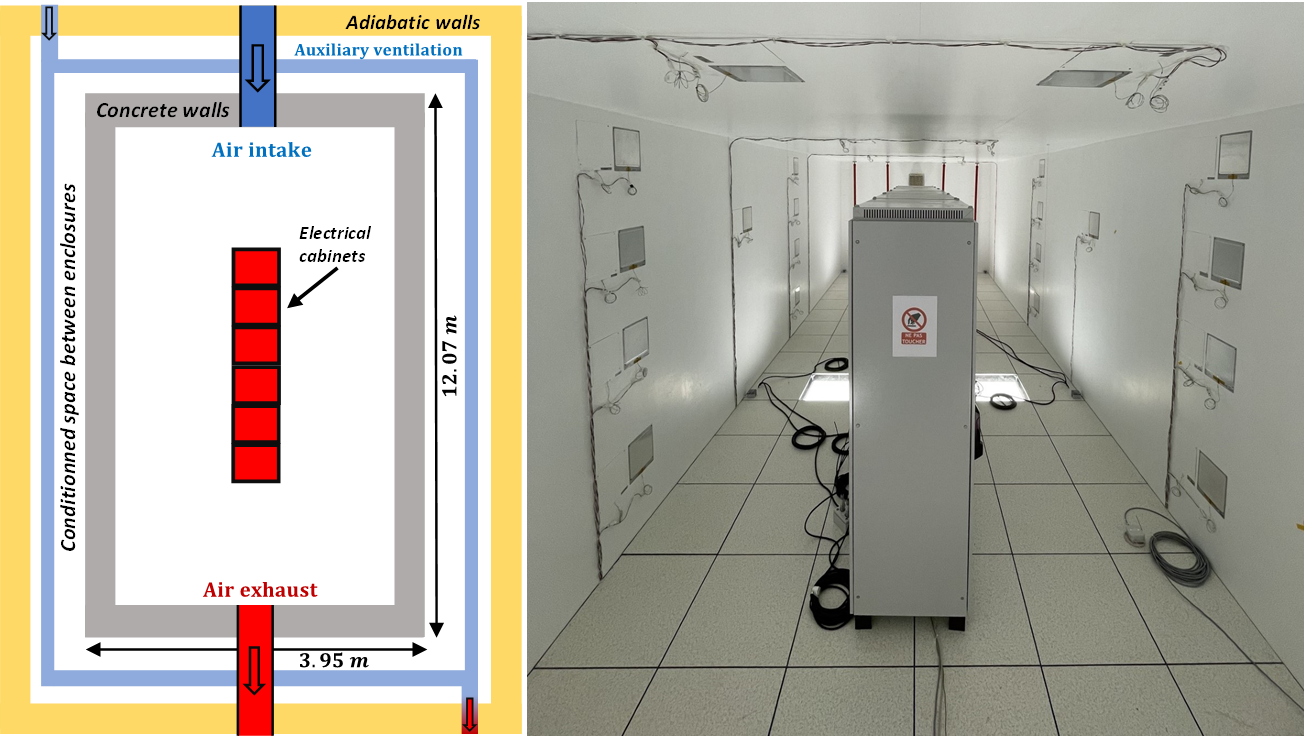
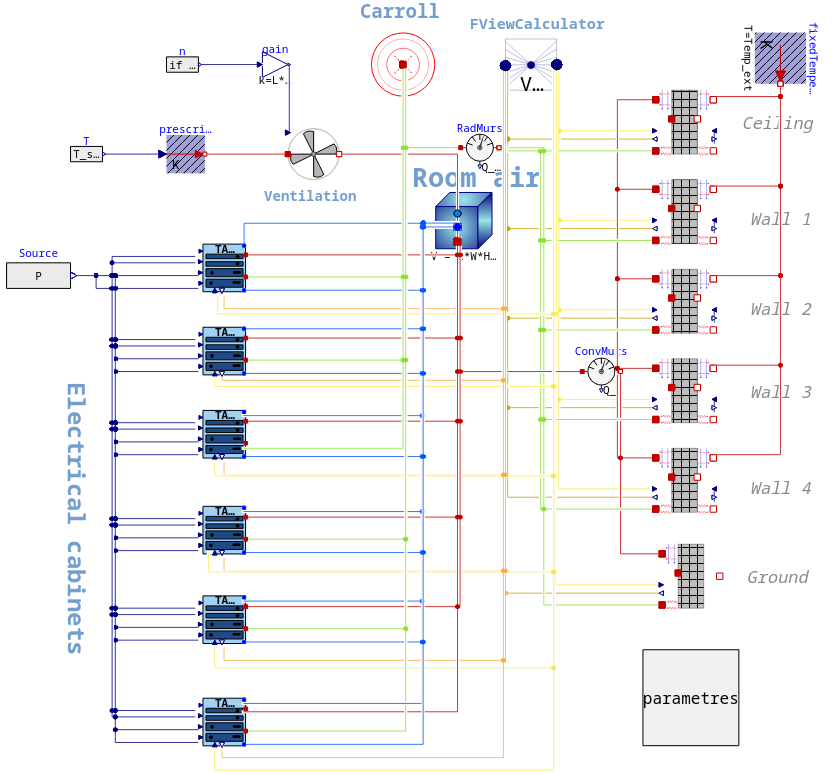
This room was modelled with TAeZoSysPro, and the calculated temperatures were then compared to:
- the experimental measurements ;
- a CFD model developed with code_saturne.
The nodal model correctly reproduces the average air temperature, with a tendency to overestimate: it assumes a homogeneous temperature across the volume and therefore does not represent thermal stratification. CFD remains more accurate on the average temperature in steady state.
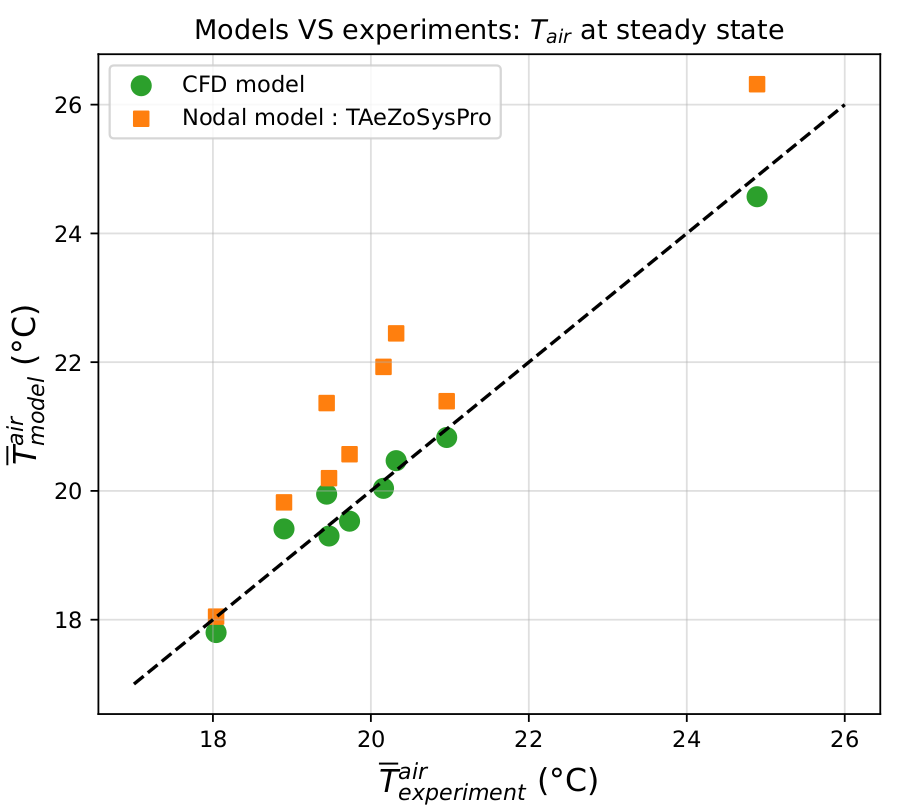
The two approaches are therefore complementary:
- the system model to quickly analyse transients and multiply scenarios;
- the CFD to study local and three-dimensional phenomena.
Application case: evaporation, condensation and steam breach
For scenarios with steam release, the models were compared to the containment response tests of the Carolinas-Virginia Tube Reactor, a reference for evaluating steam condensation models under conditions representative of a containment structure.
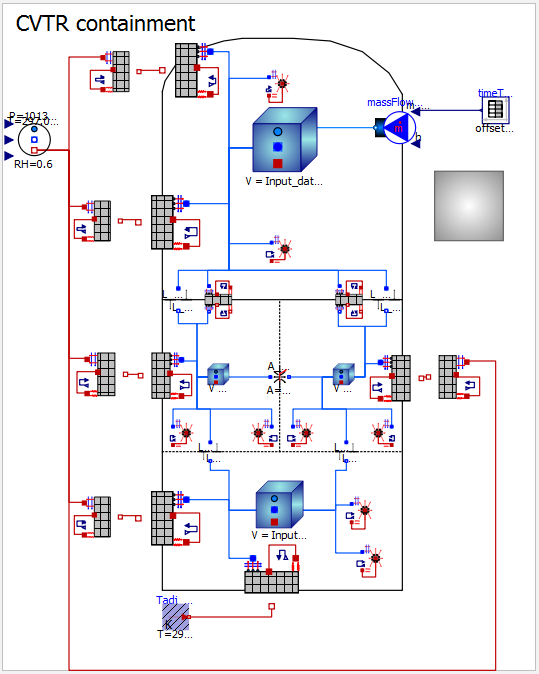
TAeZoSysPro allows for simultaneous simulation of:
- the evaporation of the liquid;
- the gradual replacement of air with steam;
- the condensation on the walls;
- the heating of the structures;
- the evolution of temperature, humidity and pressure.
The models were notably compared to a simple pressure cooker test and to the response tests of the CVTR enclosure. The initial results reproduce the observed physical dynamics, with discrepancies mainly related to the simplification of the geometry.
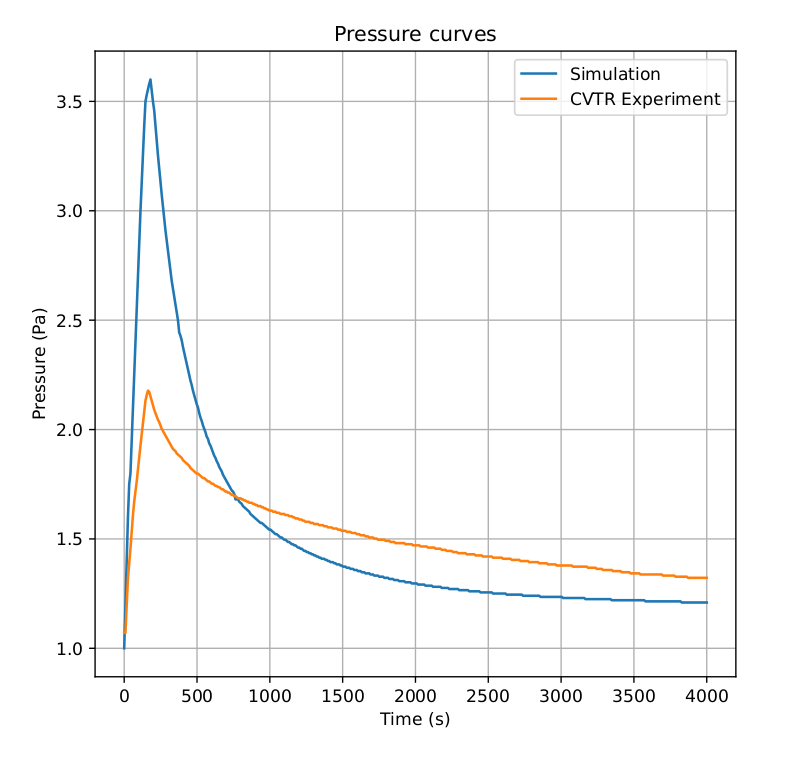
This approach can be used to study water-steam breaches, boiling pools or, more broadly, mass and energy discharges in a confined volume.
A tool to compare design solutions
Once the model is built, it becomes possible to quickly compare several configurations :
- modification of a ventilation flow rate ;
- addition of redundancy or emergency cooling ;
- change of a control threshold ;
- modification of the characteristics of a piece of equipment ;
- evolution of ambient conditions ;
- taking into account a heatwave situation.
Parametric studies then allow for the identification of influential parameters and help avoid oversizing a system based on unnecessarily penalising assumptions.
Limits and choices of the level of modelling
A nodal approach generally assumes a homogeneous temperature in each represented volume. It therefore does not allow, on its own, for the precise description of a hot spot or complex stratification.
When these phenomena are critical, the model can be :
- divided into several zones ;
- enriched with suitable correlations ;
- completed with a targeted CFD study.
The appropriate level of detail always depends on the question posed. The challenge is to use the simplest model capable of producing a sufficiently robust justification.
Conclusion
TAeZoSysPro allows for the representation of interactions between ventilation, equipment, walls, controls, and phase changes within a single dynamic model.
This approach provides quantified answers to questions directly related to design and safety :
- will the maximum temperature be respected ?
- for how long ?
- what assumptions drive the result?
- what modifications allow for margins to be regained?
It thus constitutes a decision-making tool for the design, justification, and optimisation of industrial and nuclear installations.
To go further
This article is a simplified adaptation of the paper presented at the 16th International Modelica & FMI Conference in September 2025:
TAeZoSysPro: A Modelica Library for Thermal Aeraulic and Buildings Thermodynamics Calculations, Pascal Borel, Rafik Moulouel, Félix Marsollier and Antoine Chupin — DOI 10.3384/ecp218293.
Authors
Antoine Chupin
CEO
A desire to develop expertise and to make SIL3X a constant technical emulation environment led to the creation of SIL3X. He wears the hat but his role is primarily to ensure that the teams enjoy their work.
Félix Marsollier
Scientific Director
Passionate about Physics, with an insatiable curiosity, committed to decarbonisation. Felix is capable of modelling complex phenomena in two shakes of a lamb's tail to quantify and analyse more effectively.