Introduction
In an electrical room, a control room or an industrial building, modelling thermal exchanges by considering that all loads are dissipated into the air is a cautious approach, but it can lead to oversized ventilation equipment.
During a loss of ventilation, a power variation or an external climatic event, it is important to value the thermal inertia of the equipment, walls and structures. These components exchange heat or cool the ambient air through natural or forced convection phenomena, which has a significant impact on the evolution of the room temperature over time.
To analyse these phenomena, SIL3X has developed TAeZoSysPro, a library in Modelica language intended for transient thermo-aeraulic calculations using a zonal approach.
A library born from an industrial need
The densification of electrical equipment in modern installations has concentrated thermal dissipations in reduced volumes. Two families of transients have become structural for design:
- the loss of ventilation, which conditions the qualification of thermosensitive equipment and the habitability of premises;
- the mass and energy releases, such as a breach in a water-steam circuit or the boiling of a pool.
These subjects require models capable of simultaneously representing equipment, walls, ventilation, radiative exchanges, and phase changes — and above all, doing so in a justifiable manner.
TAeZoSysPro is the result of this dual requirement: the knowledge of phenomena from EDF's R&D, and the industrialisation of the tool for use in regulated studies.
Limits of a "classic" thermal balance
A simplified approach often represents a room by a single air temperature, walls at imposed temperature and a constant dissipated power. It is useful for a quick estimate, but determining phenomena are not considered:
- the thermal inertia of concrete, equipment and structures;
- the progressive propagation of heat in a wall;
- the exchanges by natural convection between the air and the surfaces;
- the radiative exchanges between a warm cabinet, the walls, the floor and the ceiling.
In a room containing sensitive equipment, these simplifications can lead to underestimating or overestimating the grace period before reaching a temperature threshold during a loss of ventilation, for example.
A zonal approach designed for transient studies
TAeZoSysPro is based on a 0D–1D zonal modelling: the room is described by thermal volumes and physical connections between these volumes.
This approach allows for the retention of essential phenomena while being quicker to construct and simulate than a complete CFD model:
- air volumes and ventilation flows;
- internal heat sources;
- conduction in simple or multilayer walls;
- energy storage in solid masses;
- natural or forced convection;
- radiation between surfaces;
- ventilation represented by its enthalpy balance.
The library is written in Modelica, an acausal physical modelling language. Components can thus be assembled like the elements of a real system: room, walls, cabinet, ventilation, heat exchangers, and thermal masses.
Representing the inertia of buildings and equipment
A concrete wall, a metal cabinet, or a mass does not react instantly to a temperature change. Their thermal capacity particularly depends on their mass and specific heat.
TAeZoSysPro represents this energy storage and, for the walls, can discretise the thickness to follow the gradual diffusion of heat. Therefore, it is not limited to a global thermal resistance: the model also reproduces the time-lag effect of the masses.
It is particularly useful for answering questions such as :
- how long does a room remain below the allowable temperature after ventilation stops ?
- what is the actual effect of a heavy wall or added insulation ?
- at what rate does a hot piece of equipment influence the ambient temperature ?
- can a surface temperature become penalising before the average air temperature ?
Convection and radiation : two complementary exchanges
To maintain a zonal approach, radiative exchanges are calculated via an average radiant temperature and shape factors. This simplification is suitable for geometries representable by equivalent surfaces; it must be parameterised judiciously for heavily shaded or very complex configurations.
Qualification for nuclear use
A scientific calculation tool used in a safety demonstration must be verified, validated, and maintained. SIL3X carries this approach for TAeZoSysPro:
- a theoretical note describing the equations, assumptions, and correlations implemented;
- a qualification note structuring the verification and validation according to the approach of guide no. 28 of the ASNR;
- automated non-regression tests and Modelica validation tests, so that the qualification file remains consistent with the current version of the library;
- a configuration management under Git, ensuring the reproducibility of results and the traceability of developments.
The qualification of version 4 is currently underway. Organisations wishing to be associated with it during this phase can benefit from preferential access conditions to the qualification file before its general availability.
It should be noted that new versions mainly bring new components and usability improvements, while preserving the physical models of already validated components.
Example
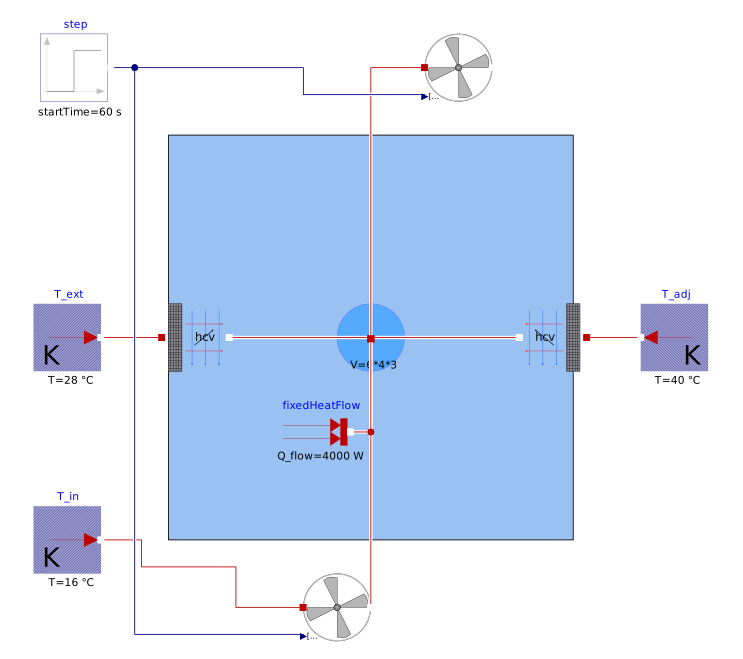
Case study :
- room of 6 × 4 × 3 m ;
- walls and concrete slab of 20 cm thickness ;
- a cabinet dissipating 4 kW ;
- imposed outdoor temperature ;
- Ventilation stopped after 60s.
A first case is carried out, close to classical sizing studies with all the thermal load dissipated directly into the air, and exchanges at the wall modelled by a fixed temperature and a fixed exchange coefficient (here 3 W/m²/K)
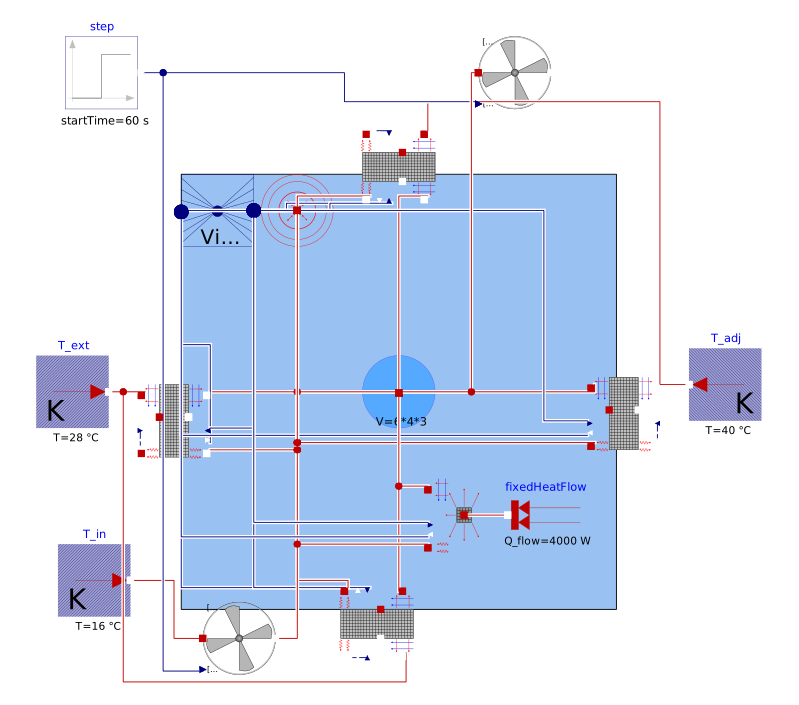
A system model is compared with this first model, taking into account radiative exchanges, heat storage in the walls, variable heat transfer coefficients, and a more detailed modelling of the heat dissipator.
The room temperature is then calculated over the duration of the transient for both models. The blue curve represents the simple model, which is the most classic approach to HVAC sizing, and the orange curve the system model, taking into account the interactions between the different components of the room.
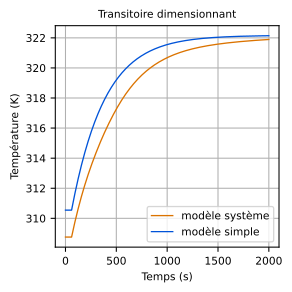
Both models are initialized in steady state with functional ventilation.
In the steady case, a difference of 2°C is observed in favour of the more detailed model. This difference is mainly related to storage in the metal masses and the walls.
In order to compare the transient part, the models are reset to 37°C with a loss of ventilation from the start of the simulation. It is possible to observe a delay of 1 minute for the grace period before a temperature of 45°C is reached. This delay can be explained by the variable exchange coefficients at the walls, as well as by the modelling of the walls.
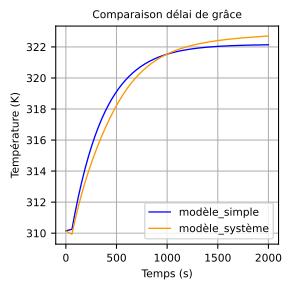
A gain of more than 10% on the grace period calculated to reach 318 K is observable between the two models.
Conclusion
In high-stakes application areas, a single degree of deviation during an accidental transient can jeopardise the entire sizing of a ventilation system. In the worst case, this can lead to costly material modifications to meet temperature requirements.
TAeZoSysPro allows for the consideration of a wide variety of phenomena within a modular transient model, suitable for the design and analysis studies of industrial premises. Margins are thus quantified precisely thanks to a qualified tool that meets the project's requirements.
This dynamic modelling approach is notably used by SIL3X for the sizing of nuclear ventilation systems and the verification of their behaviour in transient conditions.
Do you wish to assess the thermal performance of a room, the protection of sensitive equipment, or the conditions of habitability? Contact our teams to define a model suitable for your installation.
Authors

Nicolas Cardin
Business Development Director
A Doctor in fluid mechanics, he has crossed to the dark side and taken on a sales role by joining SIL3X. Capable of juggling between technical discussions and client needs, he follows missions and attends various trade shows to meet you.