Sizing and choice of HVAC system architecture
Meet safety requirements and criteria while physically quantifying margins.
Ventilation is a support function of equipment that ensures normal operation or must remain available under accidental conditions. In new nuclear projects as well as in the developments of the French nuclear fleet, its role in defence in depth has become increasingly important.
Nuclear ventilation must today ensure optimal operation in all seasons, including under extreme outdoor conditions, but also in exceptional situations, such as a loss of voltage. The availability of backup equipment depends on it: poor control of temperature or humidity can jeopardise the qualification of safety classified materials.
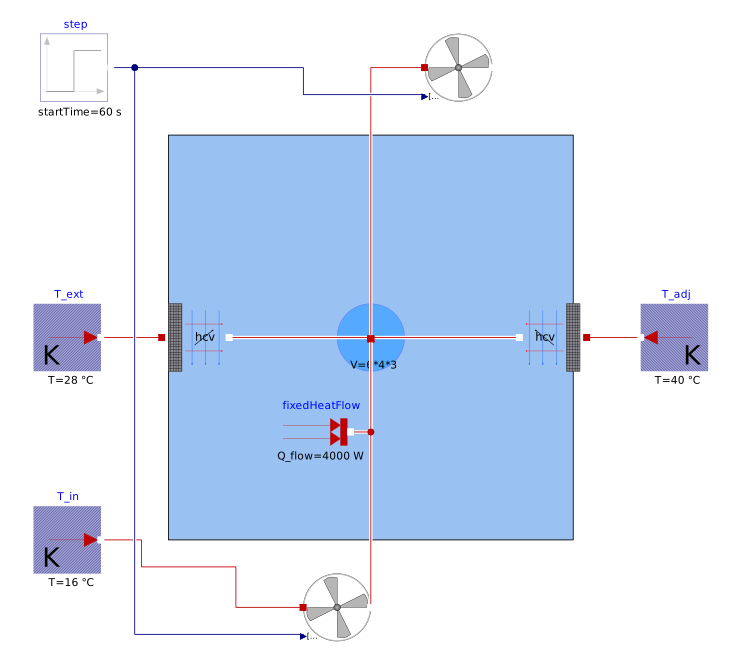
The constraints on ventilation systems are therefore strong: they must be functional both at low load and at high load. Poor sizing can lead to cycling phenomena, result in oversized and energy-consuming equipment, or, in the worst case, prevent the fulfilment of their function.
These systems are generally sized based on steady-state operating points, but must also ensure specific operations during transient phases. The modelling assumptions are then very different: some physical phenomena that are negligible in steady state can become critical in transient.
Having a model capable of quickly simulating these two types of situations, while taking into account the relevant physical phenomena in each case, allows for better quantification of margins and reliability of sizing and architectural choices.
For these studies, we use the modelling language Modelica, suitable for representing complex thermo-fluid systems and coupling their various components. SIL3X also contributes to the OpenModelica consortium and develops its own model libraries to meet the specific needs of nuclear ventilation studies.
This mastery of modelling allows us to go beyond the use of standard models. We specifically develop bespoke tools for sizing and justification needs, including TAeZo, a qualified library in accordance with ASN guide no. 28, dedicated to the simulation of ventilation systems.